Chicano black and grey is a tattoo style that came out of Mexican American Los Angeles: soft gray wash instead of packed color, a single needle instead of a heavy liner, and a set of images that carry real weight for the people wearing them. It is what I have built my work around, and it is what I get asked about more than anything else.
Most of what gets posted online as "Chicano style" is the imagery without the technique, or the technique with no idea what the imagery means. This is the long version: where it came from, what defines it on skin, what the main images carry, and what I watch people get wrong.
Where the Chicano tattoo style came from
It came out of Mexican American neighborhoods in Los Angeles and out of California prisons, and it reached tattoo shops in the 1970s. Nobody invented it in a studio. People invented it working with what they had.
The pachuco era
Pachuco culture emerged in the late 1930s in El Paso, Texas, and flourished among Chicano men in Los Angeles through the 1940s: zoot suits, ducktails, chains, and caló, the half English half Spanish slang. It faded in the 1960s, but the look and the attitude got handed down. Tattoos were part of it, usually small, on the hands and forearms, and usually put in by hand rather than by machine.
Guitar strings and tape player motors
Black and grey as a working method came out of California prisons, within Chicano and cholo culture from Los Angeles, before it ever reached a shop. Guitar strings got sharpened into needles. Cigarette ash and pen ink got thinned into a wash. Small motors pulled out of cassette players ran the machines. It was called jailhouse style, or joint style, before anybody called it black and grey.
Here is the part people skip: the limits created the look. With one needle and thinned pigment you cannot lay a bold outline and you cannot pack saturated color. What you can do is build tone, one light pass at a time, until a face appears. Every defining trait of the style traces back to that constraint.
Good Time Charlie's and the move into shops
Starting in the mid 1970s, the style crossed into professional shops and picked up the name black and grey. A shop called Good Time Charlie's Tattooland in East Los Angeles is where much of that crossing over happened. Charlie Cartwright, Jack Rudy and Freddy Negrete are the names attached to it, with Ed Hardy also credited for carrying it to a wider audience.
What changed was the equipment, not the thinking. Same one-needle approach, now with real machines and real pigment. That is the tradition I work in, and it is why I call my work black and grey Chicano realism rather than just realism.
What actually defines the style on skin
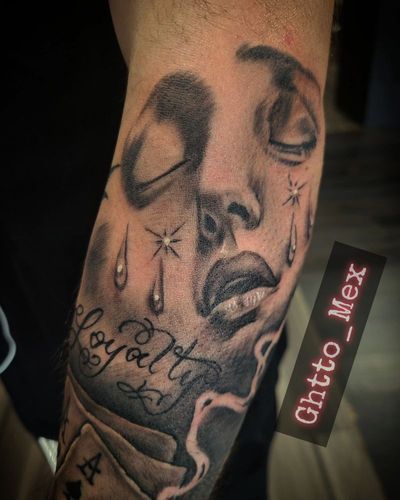
Four things: a single needle or a very tight grouping, gray wash built in layers, high contrast, and negative space doing as much work as the ink. There is no bold outline in the traditional American sense, and that absence is the reason the style reads differently from across a room.
- Single needle and fine line. Thin line weight that varies inside one piece. A jawline might be a whisper and a hat brim a firm edge, in the same tattoo.
- Gray wash. Black diluted to a range of values and laid down in passes. You are not filling an area, you are building it up until it reads as light falling on something.
- High contrast. Deep blacks next to untouched skin. This work is dramatic on purpose. It is lit like a photograph with one hard light source, not like a flat illustration.
- Negative space. Most of the white in these pieces is not white ink. It is skin I never touched. Deciding what to leave blank is most of the design work.
- Composition over outline. With no containing black line, the piece holds together through value and shape alone. Get the composition wrong and no amount of shading rescues it.
| Element | Traditional American | Chicano black and grey |
|---|---|---|
| Outline | Heavy, uniform black | Thin, varied, often absent |
| Color | Bold and packed, limited palette | Black thinned into gray values |
| Shading | Secondary to the line | The entire point of the piece |
| Light source | Usually implied or none | One clear, hard light source |
| Bare skin | Gets filled | Left bare on purpose, it is the highlight |
| What carries it at 10 feet | The outline | The contrast |
One consequence: this style is slower. A design that takes three hours as bold traditional work takes longer in gray wash, because tone gets built in passes instead of dropped in once. That is not me stretching a session. That is the method.
The iconography and what it carries
The images in this style are not decoration, and most of them are older than tattooing. If you are going to wear one for the rest of your life, you should know what it says.
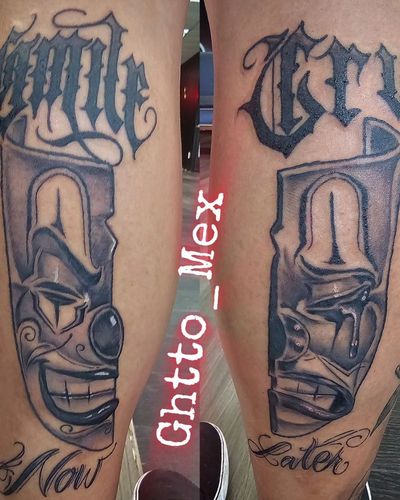
Smile now, cry later
The two masks come from ancient Greek theater, where actors performed in masks and comedy and tragedy each had a face of their own. Thalia is the muse of comedy, Melpomene the muse of tragedy. The phrase attached to them in Chicano culture is also the title of a 1966 record by Sunny and the Sunliners on the Key-Loc label, a lowrider oldies standard.
It means discipline, not mood. You hold the feeling until you are somewhere you can let it out. People ask for it because it looks good on a forearm, which is fine, but I tell them what it says first.
La Catrina
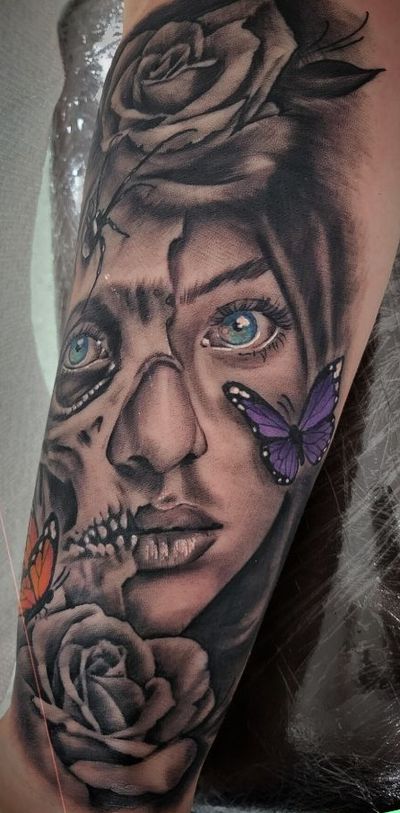
José Guadalupe Posada made the original zinc etching around 1910 to 1912, and it was first published in 1913 in a satirical broadside. The name translates roughly to "the dapper female skull," and Posada's target was class pretension, people denying where they came from. Diego Rivera put her in his 1946 to 1947 mural "A Dream of a Sunday Afternoon in the Alameda Park," dressed her in a Tehuana skirt and gave her a feathered serpent boa referencing Quetzalcoatl. That is where she stopped being a cartoon and became a national symbol.
When someone asks me for a "sugar skull girl," a Catrina is almost always what they mean. She makes a stronger piece once you know she started as a joke about pretending to be something you are not.
Our Lady of Guadalupe
The account is specific, and so is the image. In that account, she appeared to Juan Diego at Tepeyac Hill, in what is now northern Mexico City, between December 9 and 12 of 1531, and the image was left on his tilma, an Aztec cloak. That cloth hangs in the Basilica in Mexico City. Her feast day is December 12.
The elements are not optional: hands clasped in prayer, head tilted, eyes lowered, a pink tunic with a floral pattern, a blue-green mantle edged in gold and covered with eight-pointed stars, a black sash, a crescent moon beneath her feet, an angel with eagle wings holding her up, and a sunburst behind her.
If you bring me a reference where the mantle is the wrong color, the stars have been dropped, or the angel got cropped out to save room, I will say so. This is where I get particular about religious pieces. Do it right or pick a different subject.
Rosaries, clocks and roses
A rosary is a devotional object, not a necklace. Wrapped around a forearm or threaded through praying hands, the beads and the crucifix should be correct, not approximate. A clock almost always marks a specific moment, usually a birth or a death, so bring me the actual time and I will set the hands to it. Roses are the connective tissue of the whole style, which is exactly why a lazy rose ruins a good piece.
Lowriders and the street
Lowriding started in Southern California in the mid to late 1940s among Mexican American young people: low and slow, deliberately the opposite of the hot rod. California Vehicle Code section 24008 took effect January 1, 1958 and made it illegal to run a car modified to sit below the bottom of its wheel rims. In 1959 a mechanic named Ron Aguirre got around it with a hydraulic setup that let the driver raise the car on a switch. Whittier Boulevard in Los Angeles became the strip.
So a lowrider in a tattoo is not just a nice car. It is engineering that exists because somebody wrote a law against it. Honor that with correct body lines and a correct year, not a generic sedan.
Payasa and payaso
Clown makeup on a woman or a man. Same idea as the masks, moved off a prop and onto a face, which makes it harder to look away from. It also gives an artist a reason to push contrast, because painted skin next to bare skin is the kind of value jump this style feeds on.
Family portraits and lettering
Portraits are the anchor of Chicano black and grey. Grandmothers, children, people who have passed. The technique was built to do exactly this, which is why it suits portraits and memorials so well. If the person in the photo mattered to you, the reference photo matters more than the artist does.
Old English and script grew up alongside cholo graffiti and the placa, the calligraphic neighborhood lettering. It is a real discipline with real rules about weight and spacing, and it is the thing I see undersized more than anything else. Read sizing lettering for life before you commit to a name across a collarbone.
What people get wrong
Two kinds of errors, cultural and structural. Both are free to fix before the needle starts and impossible to fix after.
- The Aztec sun stone is not a calendar. Its name is the Piedra del Sol. It was dug up on December 17, 1790 at the Zócalo in Mexico City, carved between 1502 and 1520 under Moctezuma II, roughly 12 feet across and about 54,000 pounds of basalt. It uses calendar glyphs to talk about cycles of time, but it does not function as a calendar, and archaeologists read it as a ceremonial basin or altar. Wearing it is not the problem. Designing it without knowing what the four previous eras around the center face are is. That is what I work through before drawing Aztec and cultural work.
- Aztec is not Maya, and neither is Inca. Three separate civilizations, in some cases thousands of miles apart, in some cases centuries apart. Image boards mash them together constantly. Bring me a "Mayan warrior" that is actually an Aztec eagle warrior in Incan dress and I will untangle it with you.
- Copying somebody else's tattoo. Especially a memorial, or anything marking a specific affiliation. If it belongs to a person or a family, it is theirs. I will draw you something in the same tradition, never the same piece.
- Affiliation work. I do not put claims on people. Neighborhood markings, anything that labels you as belonging to something specific. I will tell you no, and I will tell you why.
- Sizing it like line work. Gradual tone needs physical room. A portrait squeezed into a panel that would suit a bold traditional rose has nowhere to put its mid-tones, and the mid-tones are the tattoo.
- Treating it as pure aesthetic. You do not have to be Mexican American to wear this style. You do have to know what you are wearing. That is the difference between honoring a tradition and decorating yourself with one.
How it holds up over the years
Gray wash ages well in one specific way and poorly in another, and the design has to account for both on day one. These pieces have no hard outline to blur outward, and a blurring outline is what gives heavily lined work its fuzzy border. What they do lose is contrast, and contrast is the entire style.
So I leave more bare skin than looks right when you first see the stencil. A piece packed edge to edge with mid gray looks rich for a year, then closes up into one flat value. A piece with real separation between the darks and the untouched skin has room to lose some contrast and still read. For the full comparison I wrote about black and grey versus color separately.
How I build a Chicano piece, and what to bring me
Bring reference and bring specifics: the actual photo, the actual time on the clock, the actual date, and a clear idea of placement. I draw custom for this style every time, because a Catrina designed for a calf and a Catrina designed for a forearm are two different drawings.
I will also tell you the truth about size. If your idea needs eight inches and you want it in four, I will say so before you have paid anything, because I would rather lose the booking than put out a piece that turns to mush in five years. Look through the gallery and see what a given amount of room actually buys you.
Quality takes time. Excellence takes experience. And neither comes cheap. I'm not the artist for bargain hunters.
My rate is $150 an hour for large and ongoing work, small pieces are quoted flat, and a deposit holds the date. I am at 5920 W 111th St in Chicago Ridge, Monday through Saturday, 12pm to 7pm, closed Sunday. Everyone getting tattooed is 18 and over, no exceptions, and Illinois law does not allow a parent to consent on your behalf. If you have a Chicano piece in mind and you want it done properly, start here or call the shop at (708) 770-2754.
Don't be average. Be set apart.
Quick answers
What is the Chicano tattoo style?
It is a black and grey tattoo style that came out of Mexican American Los Angeles, built on a single needle or very tight needle grouping, gray wash laid down in layers, and high contrast. Instead of a bold black outline it holds together through value and negative space, so most of the bright areas are bare skin rather than white ink.
Where did Chicano black and grey tattooing come from?
The working method developed in California prisons, within Chicano and cholo culture from Los Angeles, using guitar strings for needles, thinned pen ink and ash for pigment, and motors pulled out of cassette players. Starting in the mid 1970s it crossed into professional shops, notably Good Time Charlie's Tattooland in East Los Angeles, where Charlie Cartwright, Jack Rudy and Freddy Negrete worked.
What does a smile now cry later tattoo mean?
The two masks come from ancient Greek theater, where actors performed in masks and comedy and tragedy each had a face of their own. In Chicano culture it means discipline rather than mood: you carry the feeling in public and let it out in private. The phrase is also the title of a 1966 Sunny and the Sunliners record on the Key-Loc label.
Is the Aztec sun stone actually a calendar?
No. Its name is the Piedra del Sol, it was unearthed on December 17, 1790 at the Zócalo in Mexico City, and it was carved between 1502 and 1520 under Moctezuma II. It carries calendar glyphs that point to cycles of time, but it does not function as a calendar, and archaeologists read it as a ceremonial basin or altar.
Does Chicano black and grey hold up over time?
It ages differently than heavily lined work. With no hard outline there is no border to blur outward, but contrast is what fades, and contrast is the whole style. That is why the design has to leave more bare skin than looks right on day one.