Sometimes I look at a photo of an old tattoo and tell somebody that what they want is not a cover-up problem yet. It is a fading problem first. That is not an upsell, because I do not do the fading. It is a drawing call, and it comes down to one thing: how many values I have to work with over that patch of skin.
Most of the cover-ups I do go straight over the original. A smaller share need the old piece lightened first. The broad version of that question is whether any tattoo can be covered up. This is the narrow one: when I ask for laser fading before a cover-up, what it buys the drawing, and what it does to your calendar.
What I mean by fading, and what I am not asking for
When I ask for fading, I am asking for the old tattoo to get lighter. I am not asking for it to be gone. Those are two different jobs.
For a cover-up I do not need the old piece erased. I need it quiet, far enough down that it stops dictating where my darks go. How many appointments that takes, and when to stop, is the laser clinic's call, not mine. Tell them you are fading for a cover-up, not removing it, and let them plan the treatment from there.
Mid-tones are the whole argument
A realistic tattoo is built out of mid-tones, not out of black. Black is only where a form ends. Everything that makes a face look like a face, or a rose look round, lives in the grays in between.
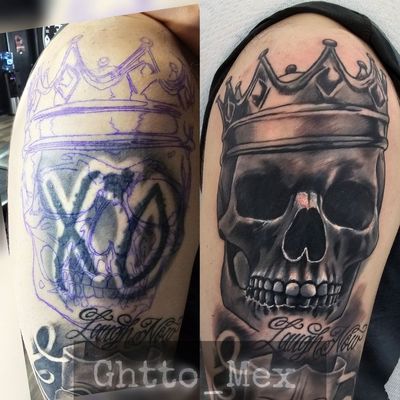
Picture a ladder of values running from bare skin at the top down to solid black at the bottom. On bare skin I have the whole ladder. Over a dark old tattoo the top half is gone, because anything I put there has to be at least as dark as what is already under it or the old piece reads through. My lightest usable value becomes somebody else's mid-tone. My mid-tones have to become black. The design goes flat in exactly the places I wanted depth.
Lighten the base a few steps and the ladder comes back. A mid-gray reads as a mid-gray again, and I can model the form. That is the entire reason I ask. It is not about hiding the old tattoo, because anybody can hide a tattoo under enough black. It is about having somewhere to go once it is hidden.
What a faded base changes for you
Three things: more designs on the table, a smaller possible piece, and fewer hours in my chair. In that order of importance.
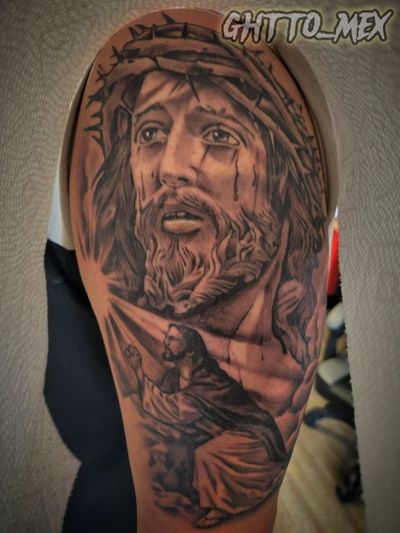
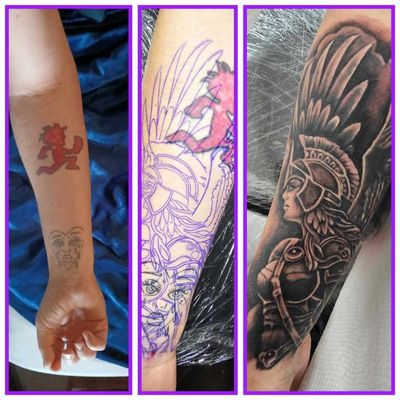
More design options. Over an unfaded piece I steer you toward work that is naturally dark and busy: heavy black and grey Chicano realism, a warrior in full shadow, a skull, dense ornamental filler. Good tattoos, but they are the only tools on the bench. Over a faded base, portraits come back into play, and so do religious pieces that need open sky behind them.
A smaller piece. Unfaded cover-ups grow. They have to, because the design needs shapes big enough to swallow the old outline and somewhere else for the eye to go. Somebody wants a forearm piece, and the honest answer is that it has to run to the elbow. A faded base usually lets the design sit closer to the original footprint. Not the same size. Closer.
Fewer hours with me. Burying old ink means packing and layering over the same ground more than once. At $150 an hour that is real money. A lighter base means the darks need fewer passes. I would rather charge you for drawing than for burying.
| What the design needs | Over the old tattoo as it stands | Over a faded base |
|---|---|---|
| Soft mid-tone shading | Gone over the dark areas. Everything there becomes black. | Available, and that is where depth comes from. |
| A face or a likeness | Rarely works. A likeness needs the full value range. | Usually on the table. |
| Open skin, sky, negative space | No. Anything left open shows the old piece. | Limited, but possible. |
| Size | Has to grow past the original footprint, often by a lot. | Can sit closer to the original footprint. |
| Color | Pushed dark and saturated so it does the hiding. | Wider range. Lighter tones become usable. |
| Hours in the chair | More. Multiple passes to bury the old ink. | Fewer. The darks go down in less time. |
When I ask for it, and when I do not
I ask for fading when the old piece is dark, solid or hard-edged, or when the thing you want over it is delicate. I skip it when the old work is already light, or small, or when your design is going dark anyway.
I usually ask for fading when:
- There is solid black fill, a blackout band or a heavy tribal outline underneath.
- The lettering is bold and the letter shapes read through anything I put over them.
- There is saturated color under a design you want in black and grey.
- You want a face, a portrait, or anything where a likeness has to be right.
- You want the new piece to stay roughly the size the old one is now.
- The composition needs open skin: sky, clouds, water, room to breathe.
I usually do not bother when:
- The old piece is years old, soft and already low contrast.
- It is small enough that a bigger design absorbs it without effort.
- Your design carries enough black on its own merit to cover it honestly.
How this works on the calendar
Plan in months, not weeks. Fading happens on somebody else's calendar, and I will not hold a tattoo date for you until we can both see what the base is going to look like.
- Send me a photo first. Daylight, no flash, the whole tattoo in frame, plus a rough measurement in inches. That costs nothing and it is the fastest way to find out whether fading is part of this at all.
- If I ask for fading, I point you somewhere. You book that on their calendar. Tell them the goal is a cover-up, not removal.
- Send me a new photo when they are done, or partway through. I design from the base in front of me, not from a picture taken last spring.
- Then we set a date and take a deposit. The deposit holds that date, and I set that date only after the clinic tells you the area is ready to be tattooed. How deposits work is on the pricing and deposits page.
If there is a date attached to this, a wedding or a summer where you want it visible, start the conversation about a year out. People come to me in March wanting a faded cover-up finished by June, and I cannot promise that, because the fading half of the timeline belongs to the clinic. More on timing in booking around summer and the gym.
I do not do the fading myself
I am a tattooer. I do not run a laser and I am not going to pretend otherwise. I refer that part out and then I do my half.
Do one thing properly and send people to somebody who does the other thing properly. When you come back, my job is to draw the piece the new base allows, which is almost always a stronger drawing than the one we would have settled for months earlier.
Quality takes time. Excellence takes experience. And neither comes cheap. I'm not the artist for bargain hunters.
Start with the photo
Text a clear photo of the old tattoo to (708) 770-2754, or message me at @tat2nestuhh, and tell me what you want there instead. You will get a straight answer, including the ones people do not want: that it has to be bigger than you hoped, that it needs fading first, or that the idea you brought is too light to do the job. That conversation is cheaper before the needle than after it.
When you are ready, booking is here and the finished cover-ups are in the gallery. I am at 5920 W 111th St in Chicago Ridge, Monday through Saturday, 12pm to 7pm.
Quick answers
Do I always need laser fading before a cover-up tattoo?
No. Most of the cover-ups I do go straight over the original. I ask for fading when the old piece is dark, solid or hard-edged, or when you want something delicate like a portrait over it.
Why does fading the old tattoo first change what you can draw?
A cover-up gets its depth from mid-tones, not from black. Solid old ink forces everything above it to go to my darkest value, so the new piece flattens exactly where I wanted modeling. A lighter base gives the mid-range back.
Does the old tattoo have to be removed completely?
No. Fading for a cover-up and full removal are different jobs with different endpoints. I need the old piece quiet, not gone. How far to take it is the laser clinic's call, so tell them it is for a cover-up.
Does Nestor do the laser fading?
No. I am a tattooer and I do not run a laser. I refer that part out, you book it on their calendar, and you come back to me with a fresh photo of the current base.
How far ahead should I book a cover-up that needs fading first?
Plan in months, not weeks. If there is a date attached, like a wedding or a summer, start the conversation about a year out. I will not hold a tattoo date with a deposit until we can both see what the base will look like.