No. Not every tattoo can be covered up, and I would rather tell you that now than take your deposit and let you find out in the chair. Most tattoos can be covered, and I cover a lot of them, but there is a real group that cannot be covered well at the size you want, in the spot you want, with the design you want. That group is larger than people expect.
The phrase is the problem. "Cover-up" sounds like deleting, and it is not.
A cover-up is a design problem, not a delete button
The old ink stays in your skin. Nothing I do with a machine removes it. What I am doing is drawing a second tattoo over the first, bigger and darker and busier, and placing its solid blacks and deepest shadows exactly where the old ink sits, so your eye reads the new image and never goes hunting for what is underneath.
That is the whole craft of it. I am not hiding a tattoo, I am building a new one whose dark areas are shaped by somebody else's old lines. Every decision after that comes back to one question: can I put enough dark in the right places to win?
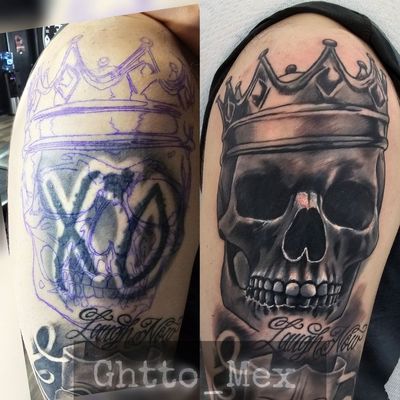
It is also why light, airy, fine line designs almost never work as cover-ups. A delicate flower in thin gray has nothing to fight with. If you want something soft and open, put it on clean skin.
The four things I check before I say yes
Every cover-up consultation I do runs through the same four checks, in this order. If one of them fails badly enough, I say no, and I say it before you pay a deposit.
1. How dark and how solid the old ink is
This is the first thing I look at and it decides the most. Faded, thin, ten-year-old linework gives me room to work and opens up a lot of design options. Heavy solid black, old tribal, a blackout patch or dense saturated color is a different animal, because I can only go darker than what is already there, and past a certain point there is no darker left.
Send me a clear daylight photo, no flash, no filter, straight on. Flash lies: it flattens old ink and makes it read lighter than it is, and then I quote you a design I cannot deliver.
| What is on you now | How it usually goes |
|---|---|
| Thin, faded linework, ten years or older | Easiest case. Wide range of subjects, and it does not always have to go much larger. |
| A name or script in thin black | Usually workable, as long as the new piece is a good deal bigger than the lettering. |
| Mid-tone gray shading, no hard black | Workable. Realism and portrait subjects handle this well. |
| Solid black tribal or a blackout patch | Hard. The new design has to be built out of black and heavy shadow, or the old ink gets laser faded at a clinic first. |
| Dense saturated color over a wide area | Hard. Expect laser, and expect the new piece to go considerably larger. |
| Hands, fingers, neck, feet, anything on the head | Hardest, no matter what the old ink looks like. |
2. How big you will let the new piece go
A cover-up is almost always larger than the tattoo underneath, and how much larger is not up for debate, it is set by the old ink. As a working rule I want about twice the footprint of the original, and on heavy black I want more, because I need room outside the old shape to put light values. With no light areas there is no contrast, and with no contrast you get a dark smudge instead of an image.
People hear "twice the size" and get quiet. I understand it. You came in wanting the problem to get smaller and I am telling you it gets bigger. But a small cover-up over a dark tattoo is a job I will not do. It fails in daylight, it fails in photos, and you will be back in two years asking me to fix it, except now we are covering two tattoos instead of one.
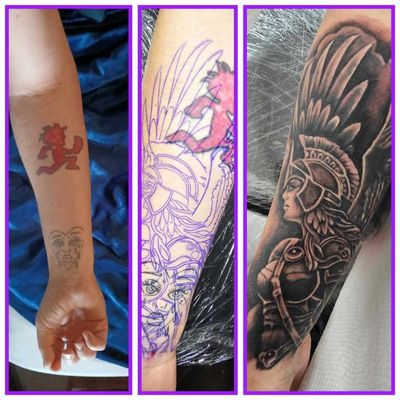
The upside of going bigger is that you stop thinking of it as damage control. Sized properly, a cover-up is just a good tattoo, and the subjects that cover well are the ones I like doing anyway: Aztec and cultural work with heavy ornamental detail, roses and filler, skulls, and portraits with deep contrast. My post on cover-up ideas that actually hide old ink goes through the specific subjects and why they earn their keep.
3. Where it sits on your body
Placement decides how much room I have and how the piece holds up over the years. A forearm, an outer arm, a thigh, a calf, a shoulder or a back gives me space to expand into and skin that takes detail and keeps it.
Hands, fingers, the sides of the neck, the tops of the feet and anything on the head are a different conversation. There is no room to go bigger, those spots do not hold fine detail the same way, and old finger tattoos usually have ink spread underneath that the new design has to fight. I turn down more hand and finger cover-ups than any other kind, and it is not because I do not want the work. Ribs, stomach and the inner upper arm sit in the middle: they will take the work, but plan on more than one sitting.
4. Whether it needs laser fading first
Some cover-ups do not become possible until the old tattoo is knocked down first, and that is a laser clinic's job, not mine. I do not laser in the shop. I will tell you plainly when a piece needs it, refer you out, and design around whatever is left when you come back.
The clinic decides how many laser visits it takes and how far apart they go, so plan on the cover-up being months away rather than next week. Understand what you are buying, too. You are not paying to erase the tattoo, you are paying to knock it back far enough that I get my design options back. Partial fading is usually all I need for the design. Tell the clinic it is for a cover-up, and how far to take it is their call. I wrote a whole post on when I ask for laser fading and when I do not, because it is the thing people push back on hardest.
The jobs I turn down
These are the ones I refuse, consistently, and the reason is the same every time. I can already see the result and it is not something I will put my name on.
- A small, light design over a solid dark tattoo. The physics do not work. You cannot put light over dark.
- Light, open fine line or single needle work over anything. Nothing to fight with. It reads as two tattoos stacked.
- Hand and finger cover-ups where the old ink is heavy. No room to expand and no way to win.
- A cover-up with a hard deadline that is too close. Rushing one is how you end up with a bad one.
- Somebody else's failed cover-up that is already maxed out on black. Sometimes the honest answer is laser before anyone tattoos you again, and how much is the clinic's call.
- A reference the client will not let me change. If the design is locked and the design will not cover, we do not have a job. I need to move the shapes.
I would rather lose the booking than put my name on a cover-up that still reads as a cover-up.
Why hearing no is cheaper than a bad cover-up
Say I take a job I should have refused. You pay for the sitting at my rate of $150 an hour and walk out with something that looks acceptable that week. Then the new ink ages, loses a little density, and the old tattoo starts showing through underneath. Now you are looking at laser anyway, on two tattoos stacked instead of one, and then paying for a third tattoo, larger again, to cover both.
That is three bills instead of one, plus years of your life with something on your arm you do not want to explain. A no from me at the consultation costs you nothing. That is the entire argument.
A no is also rarely the end of it. Usually it means "not that design, not at that size, not in that spot," and there is a version that works. My job is to find it, tell you what it costs in money and in sittings, and let you decide. The finished ones are in the gallery, where the cover-ups are marked.
What to send me before you book
Four things, and you will get a straight answer back.
- A clear photo of the existing tattoo, in daylight, no flash, shot straight on rather than at an angle.
- A rough measurement in inches. Hold a tape next to it if you can.
- What you would like to see there instead, with a reference image or two.
- Whether it has already been lasered, and roughly how many sittings you had.
Tell me up front how much bigger you are willing to go. That answer changes what I can offer you more than anything else on the list, and if it is "not much bigger," say so. I will tell you right away whether a design exists that fits inside it.
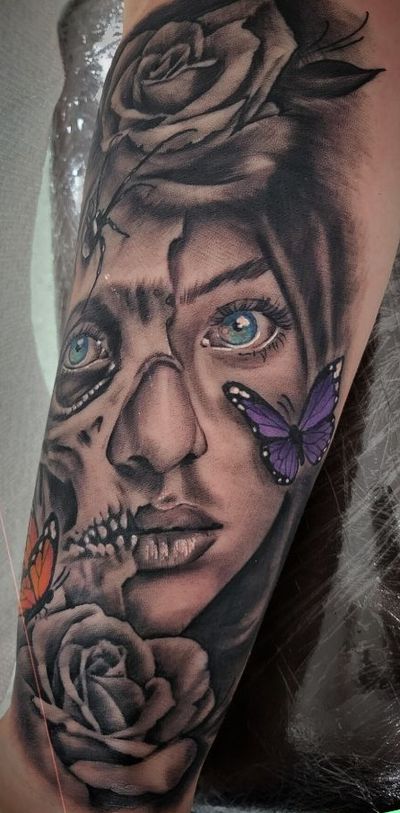
Most of my cover-ups end up in black and grey Chicano realism, because that style is built on deep contrast and ornamental detail, which is exactly what a cover-up needs. Check pricing and deposits so you know what you are walking into, then send the photo over. Quality takes time, excellence takes experience, and neither one comes cheap. I am not the artist for bargain hunters.
Quick answers
Can any tattoo be covered up?
No. Most tattoos can be covered, but heavy solid black, dense color over a wide area, and hand or finger work often cannot be covered well at the size and in the spot the client wants. In those cases the honest options are a different design or laser fading first, and whether laser suits you is the clinic's call.
Does a cover-up remove the old tattoo?
No. The old ink stays in your skin. A cover-up is a second tattoo, larger and darker and busier, whose solid blacks and shadows land exactly where the old ink sits.
How much bigger does a cover-up have to be?
As a working rule I want about twice the footprint of the original, and more over heavy black. I need room outside the old shape to place light values, because with no contrast the piece reads as a dark smudge instead of an image.
Do I need laser fading before a cover-up?
Sometimes. Partial fading is usually all I need, and it is a laser clinic's job, not something done at the shop. The clinic sets how many visits it takes and how far apart, so plan on the cover-up being months away rather than next week.
What should I send to get a quote on a cover-up?
A clear daylight photo of the existing tattoo with no flash, shot straight on, plus a rough measurement in inches, a reference for what you want instead, and whether it has already been lasered. Tell me how much bigger you are willing to go.