The reference photo is the one decision that settles how a portrait turns out. A portrait can only hold the detail that is already in the photograph, so by the time you hand me the image, most of the result is already decided. I am not inventing a face. I am reading one and carrying it across to skin.
I send back a lot of reference photos, and people sometimes take that personally. It is not personal. It is me refusing to take $150 an hour for a piece that is never going to look like the person you love.
The photo is your budget of detail
Think of the photograph as a budget, because every step after it spends some of that budget and no step adds any back. The camera already lost something the day the picture was taken. My drawing loses a little when I simplify what the lens saw. The machine loses a little more putting it into skin instead of onto paper. Then time takes its cut, because ink spreads a small amount under the skin over the years, and the tightest detail in the piece is the first thing to close up.
So I want to start with more information than the tattoo needs, not exactly enough. A photo that looks fine at thumbnail size on your phone is usually the thinnest possible budget. When the budget runs out mid-piece, I have to invent, and invented detail is where likeness dies. Nobody can tell you why the tattoo looks wrong. They just know it is not him.
Quality takes time. Excellence takes experience. And neither comes cheap. I am not the artist for bargain hunters.
Light does more for a portrait than anything else
I need light coming from one clear direction. Black and grey Chicano realism is built out of values, not outlines, so the shape of a face comes entirely from where the light stops and the shadow starts. Give me a photo with a lit side and a shadow side and I can build a skull under that skin. Give me a flat photo and I am rendering a mask.
The two lighting situations that cost me the most are direct flash and backlight. Flash fired straight at someone flattens everything and burns the forehead, the nose and the cheekbone to blank white, and there is no information in blank white. Backlight does the opposite and turns the face into a dark shape with a bright rim. Both are photos of a person. Neither is a photo of a face.
What I want is window light. Put someone a few feet from a window, turn them slightly toward it, no flash, and you get one direction of light with detail surviving on both the bright side and the shadow side.
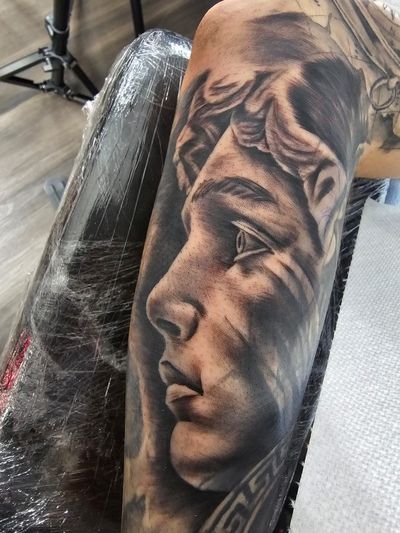
Contrast is the other half of it, and here is the part most people have never considered: your skin is the brightest value in the tattoo. I cannot add light. White ink does not stay bright in my experience, so I do not build a face on it. That means if your skin tone is deeper, the reference needs more separation between its values, not less, because I have less room to work in. A washed out gray photo becomes a washed out gray tattoo. Color realism has its own version of this problem, since kitchen light and phone auto-color make skin tones lie. If you are still deciding between the two, I went through it in black and grey vs color.
Focus and resolution: the eye test
Open the photo on the biggest screen you have and zoom all the way in on one eye. If the lashes, the edge of the iris and the wet line of the lower lid stay crisp, the photo can carry a portrait. If they turn to mush or break into little square blocks, it cannot, and nothing I do anywhere else on the face will make up for it.
Eyes are where recognition lives, with the corners of the mouth second. Everything else is supporting cast. A portrait with soft eyes and beautifully rendered hair still gets the same reaction from family, which is a long pause and then a polite sentence.
Two things fool people about resolution. First, a large file with a small face in it is still a small face. A twelve megapixel group shot where your grandmother's head is the size of a fingernail has almost nothing in it. What counts is how many pixels sit across the face, not how big the file is. Second, phone portrait mode. That depth effect often softens the hairline, the ears and the edge of the shoulders, and the hairline is exactly where a face meets the rest of the head.
Straight on, three quarter, or profile
A three quarter turn is the angle I ask for first, because it shows the planes of the face. Dead straight on with a flash is the hardest thing you can hand me, since a flat light on a flat angle gives me no structure to read at all.
| Angle | What it gives me | My call |
|---|---|---|
| Three quarter turn | The nose has a shape, the cheek has a plane, the jaw reads as a jaw | What I ask for first |
| Slight turn, near straight on | Strong likeness as long as the light has a direction | Works well |
| Straight on with direct flash | Flat planes, blown highlights, mask-like | Send me another one |
| Full profile | A striking graphic shape, but people often do not recognize someone they loved from a profile | Good design, weak likeness |
| Camera above, chin down (the selfie angle) | Enlarged forehead, shrunken chin, distorted proportions | I will not work from it |
| Camera very close to the face | The lens pushes the nose forward and shrinks the ears | Step back and zoom in instead |
What I send back
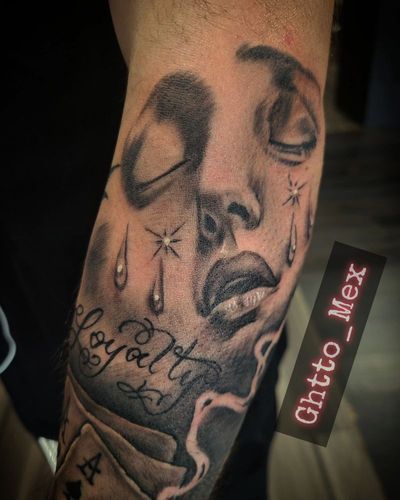
These get an honest no from me every time, and now you know before you ask. None of them are fixable on my end.
- A screenshot of a screenshot. Every save re-encodes the image and bakes in square artifacts. I cannot tell an artifact from skin texture, so I would end up tattooing the artifacts.
- A photo of a phone screen or a TV. You get glare, a grid pattern and none of the original detail.
- A framed print shot through the glass, with the window and your own reflection sitting across your father's face.
- Anything pulled out of an Instagram or Facebook post. The platform already threw most of that file away before you ever saw it.
- Beautify and skin smoothing filters. They delete the exact texture that makes a face read as a living person, and most of them quietly reshape the jaw and enlarge the eyes. Family will feel it is off and never be able to say why.
- App black and white conversions. Send me the color original. That conversion is my decision, and I make it differently for skin than an app makes it for a feed.
- Anything with the face covered. Sunglasses, a hat brim throwing shade over the eyes, a hand across the mouth, hair across the cheek.
- A photo of somebody else's tattoo of the same photo. That is a copy of a copy, and it will show.
The hardest case: one old photo of someone who is gone
This is the portrait request I get most often and the hardest one on the table. Somebody has died, there is one photo, it is small, it is from 1979, and it lived in a wallet or sat in a sunny window for thirty years. Most memorial work starts right here.
Here is what actually helps.
- Find the physical print. Take it out of the frame. Never shoot it through glass.
- Copy it properly. Lay it flat near a window in daylight, no flash, phone held parallel to the print and directly above it, filling the frame with the photo. A flatbed scan at a high setting is stronger still. What ruins it is a tilted phone shot with the shadow of your own head across the corner.
- Bring every other photo of him you can find, including the bad ones. The main photo carries the likeness. The extras tell me the truth about the face: how the eyes sat, how wide the bridge of the nose really was, which way the smile went. Ten poor photos plus one decent one is a far stronger hand than one decent photo alone.
- Bring somebody who knew him. A brother saying "his smile went up on the left" has rescued more portraits than any piece of software ever will.
About the restore-and-upscale apps: I understand why people run the old photo through one, and I will look at what it gave you. I will not build the likeness from it. Those tools invent. That smooth young face it handed back is an average of a million other faces wearing your father's haircut, and the person who raised you will catch it in about a second without being able to name what changed. I would rather work from an honest grainy original than from a confident stranger.
And I will tell you straight when a photo cannot support a tight realistic portrait. Sometimes the honest answer is a different design: the figure smaller with the detail carried by the composition around it, a pair of hands, a date, a strong graphic piece. Those still read as him. A guessed face does not.
How to send the file without wrecking it
Send the original file, not a copy of a copy. Messaging apps recompress images to keep them small, and a screenshot only captures whatever your screen was showing, which is a fraction of what the file holds.
- Email the original, or on an iPhone use Mail at Actual Size, or AirDrop it.
- A Google Drive link works and keeps the full file intact.
- Instagram DM (@tat2nestuhh) is fine for starting the conversation. Before I draw, I will ask you for the file another way.
- Do not crop it, do not brighten it, do not convert it. Send it as it is.
- Send the whole set and tell me which one looks the most like them to you. That one sentence tells me more than you think.
Your camera roll checklist for tonight
Go through your photos with this list and you will know what you have before you contact me. Ten checks, two minutes each.
- The face takes up a real portion of the frame, not a corner of a group shot.
- Zoomed all the way in on one eye, the lashes and the edge of the iris stay crisp.
- The light comes from one direction. There is a bright side and a shadow side.
- There is still detail in the shadows, and the forehead and nose are not burned to blank white.
- Nothing covers the face. No sunglasses, no hat shadow over the eyes, no hand, no hair across the cheek.
- No beautify or skin smoothing filter, and no app black and white conversion.
- It is not a screenshot, not a photo of a screen, not a save from a social post.
- The head is turned slightly rather than shot dead straight on with a flash.
- It is the original file, not one that has passed through five apps.
- It looks like how you remember them. Trust that instinct. It is usually right.
Clear all ten and we are in business. Clear eight and send it anyway, and I will tell you exactly what is missing and whether it matters.
Bring me the photo before anything else
Bring your options into the shop or send them ahead, and we will go through them together. I will tell you what that image can hold, how large the piece has to be to hold it, and where on the body it should sit. Portraits are not small tattoos. Detail needs room, and a face squeezed down too small closes up into a smudge with a haircut. You can see the scale I work at in the gallery.
Everything runs on a deposit and a date, which I lay out in how to book with me, and the hourly rate and deposit are on the pricing page. When you have the photo, book a consult. Anointed Ink, 5920 W 111th St, Chicago Ridge, Monday through Saturday, 12pm to 7pm, or call (708) 770-2754.
Don't be average. Be set apart. Start with the right photo.
Quick answers
What makes a good portrait tattoo reference photo?
Light coming from one clear direction so the face has a bright side and a shadow side, crisp eyes when you zoom all the way in, nothing covering the face, and a slight three quarter turn rather than a dead straight flash shot. The face also has to take up a real part of the frame, since pixels across the face matter more than the size of the file.
Can you tattoo a portrait from an old damaged photo?
Sometimes, and it is the most common request I get for memorial work. Bring the physical print out of its frame, copy it flat in daylight with no flash, and bring every other photo of that person you can find so I can understand the structure of the face.
Should I run the old photo through an AI restore or upscale app first?
No. Those tools invent detail, so the smooth face they hand back is an average of other faces wearing your relative's haircut. I will glance at one, but I build the likeness from the original, grain and all.
Is a screenshot okay to send?
No. A screenshot only captures what your screen was showing and re-encodes the image, which bakes in square artifacts I cannot tell apart from skin texture. Send the original file by email, AirDrop or a Google Drive link.
Does a beautify filter really matter on a reference photo?
Yes. Skin smoothing deletes the exact texture that makes a face read as a living person, and most filters quietly reshape the jaw and enlarge the eyes. Family will feel the portrait is off without ever being able to say why.